
As you can see, we have refreshed our website. The new design is simpler than before.
This change was prompted by an issue where some members were not receiving messages from our mailing list. Since it was difficult to resolve the problem at its source, we decided to take this opportunity to shift to a website centered around a “bulletin board” system.
We kindly ask all members to make a habit of checking this site regularly.
If you have any comments or suggestions, please feel free to send them to us here. Thank you for your understanding and continued support.
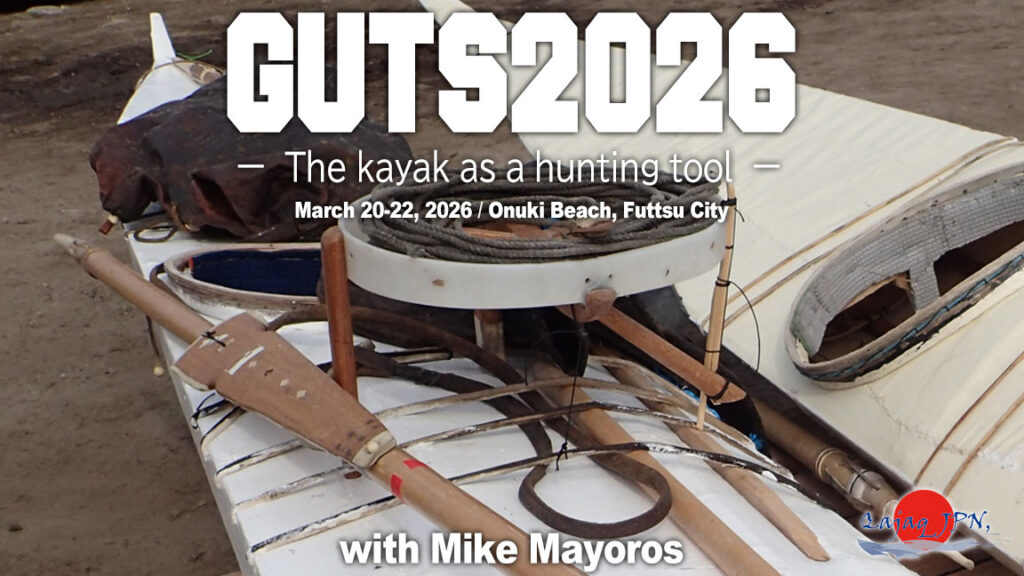
As we’ve mentioned many times on the blog and elsewhere, this year’s GUTS will put a strong focus on hunting culture.
We all enjoy practicing Greenland rolls, but learning about the cultural background behind them is never a waste of time. In fact, gaining that understanding often leads to a deeper respect for the rolling techniques themselves—and may even make them more fascinating and meaningful.
Our guest this year is Mike Mayoros from Canada. I first met Mike at the Ukee Greenland Weekend last year, and what really stood out to me was his approach to teaching—his sense of distance, his eye level, and the way he connects with students during rolling classes. He’s quite different from any other instructor I know, and I immediately felt a strong connection. That’s why I invited him to GUTS this time. I believe there’s a lot we can learn from him, not only about rolling, but about attitude and mindset as well.
We’re also preparing content beyond on-water practice. In the classroom sessions, we’ll explore the theme “The kayak as a hunting tool.” By recreating the concept of the hunting kayak and sharing discussions with participants, we hope to exchange ideas and perspectives. We’ll also cover the actual hunting process, including how game is handled, and present hunting scenes in a story-like format. Lots to look forward to!
Registration is now open — please sign up here!
Dates
March 20–22
March 20 is open to QajaqJPN members only.
Program
March 20
Rolling lecture
March 21
Morning: Classroom session
- The kayak as a hunting tool
- A closer look at hunting equipment
- Hunting strokes, rolls, and the walrus pull
Afternoon: On-water practice
- Harpoon throwing
- Walrus pull (with guidance from Mr. Uozumi)
- Recovery techniques related to these skills (mainly rolling)
Evening:
An informal talk about hunting culture at “Umineko”
March 22
Morning only: Short touring paddle
We’ll paddle from Shinmaiko to Onuki. After arriving at Onuki Beach, we’ll do a light review of rolling skills.

QajaqJPN (QJ) is a club founded in 2003 dedicated to the enjoyment and practice of Greenland-style kayaking. There are no special membership requirements—anyone with an interest in Greenland-style kayaking is welcome to join us. Please refer to our bylaws for details.
In Greenland, there is a major organization called Qaannat Kattuffiat, which oversees the country’s many local kayaking clubs. It functions much like a national association for Greenland kayak culture.
For many years, Qaannat Kattuffiat did not accept foreign members. However, in 2000, it opened its doors. Today, only three foreign clubs are officially recognized by Qaannat Kattuffiat:
QajaqUSA, QajaqCopenhagen (Denmark), and QajaqJPN.
As a member of Qaannat Kattuffiat, we carry the responsibility of preserving and passing on Greenland-style kayaking in its authentic form. Their earlier reluctance to accept foreign participation likely stemmed from a desire to prevent their cultural heritage from being misunderstood or misrepresented. We must always remember that the Greenland kayak is a gift from another culture—one that we should honor with respect. If you wish to experience and carry forward the wisdom of the Far North, we warmly invite you to join us.

QajaqJPN welcomes individuals who are interested in Greenlandic hunting culture and traditional kayaking.
Whether your interest lies in rolling, kayak construction, or the cultural and historical background behind these practices, you are warmly invited—prior experience is not required.
Membership is open to all, regardless of age, gender, or nationality.
We value mutual respect, curiosity, and a shared appreciation for the culture that has shaped Greenlandic kayaking for generations.
Our membership rules and guidelines can be reviewed here.
If you wish to join QajaqJPN, please submit the form using the button below and include your
full name, email address, and mailing address.
We look forward to connecting with you and continuing this cultural journey together.

Qaannat Kattuffiat is an organization founded by Greenlandic kayakers with a clear purpose: the preservation and continuation of a hunting culture deeply rooted in the Arctic.
The word Qaannat is the plural form of “kayak,” while Kattuffiat means “association” or “organization.” As will become clear, the name naturally traces its origins back to its predecessor, the Qajaq Club.
Its activities span far beyond paddling alone. Rolling techniques, kayak building, rope gymnastics, harpoon throwing, and the study of cultural history all form essential pillars of the organization. As part of these efforts, an annual training camp and championship—closely linked to one another—are held each year.
Today, Qaannat Kattuffiat brings together numerous clubs across Greenland, while also embracing international member clubs in the United States (QajaqUSA), Denmark (QajaqCopenhagen), and Japan (QajaqJPN).
For centuries, Greenland was truly a nation of kayakers.
Seals were the backbone of Inuit subsistence, and the kayak was the perfect tool for hunting marine mammals. Silent, swift, and precise—success depended on the hunter’s skill with both kayak and harpoon. A man’s worth was measured by his mastery of these arts.
Around the 1920s, however, change arrived. Rising sea temperatures along Greenland’s coast reduced ice coverage, and motorboats began to navigate freely. Gradually, the practical need for kayaks diminished.
In an unforgiving environment, choosing more efficient and less dangerous methods of survival was only natural. Over time, knowledge of the kayak faded across generations, and its techniques were no longer passed down. Kayaks disappeared from daily life, and the era of motorboats took hold.
Then, nearly sixty years later, an unexpected turning point emerged.
In 1983, three historic skin kayaks were loaned from the Netherlands to the museum in Nuuk. When local young people laid eyes on them, they were transfixed.
You can almost imagine them saying, “Isn’t this insane?”
These were not just boats. They were living proof that, between the 1600s and 1800s, their ancestors had mastered these strikingly elegant, almost provocative forms—hunting from them to sustain their families. The kayaks spoke for themselves.
Determined to protect and reclaim this heritage, the young generation decided to form a club.
This marked the birth of what would later become Qaannat Kattuffiat. At the time, it was known as the Qajaq Club, and its matching T-shirts proudly bore the words:
**“QAJAQ-ATOQQILERPARPUT” — We will use kayaks again! **
Founded in 1984, the club grew rapidly. By the latter half of the following year, membership had already reached 1,000. This remarkable number speaks volumes about the pride Greenlanders held—and still hold—in their kayak culture.
The Qajaq Club actively sought out elders who still carried memories of traditional kayaking, learning how kayaks were built and used, and reconnecting the present to the past.
Among these elders, Manasse Mathaeussen stands out as a pivotal figure. At a time when much of the knowledge had nearly vanished, he generously passed on his skills to the younger generation. Though already in his seventies, the number of rolling maneuvers he taught is said to have been extraordinary.
By gathering veteran kayakers deeply experienced in seal hunting, the organization revived not only techniques, but also the stories, values, and spirit of the hunting culture—bringing them back into living practice.
Today, clubs scattered across Greenland actively engage people of all ages in kayak building, rolling, rope work, harpoon skills, and cultural history. Despite the vast distances between communities, their activities remain remarkably synchronized.
That even legendary roll champion Maligiaq, while maintaining his profession as a carpenter, continues to travel the world to teach rolling and kayak construction, speaks volumes about where their priorities lie. This is not “sport” or “recreation.” It is pride—deep and enduring. In 2010, we became a part of Qaannat Kattuffiat ourselves.
The young people who once stood staring at three old kayaks in a museum, and the elders who found their way back to the kayak after many years—every one of their actions is now connected to us. Realizing this, we cannot help but feel a profound sense of responsibility.
From a small corner of Asia, we hope to continue protecting this culture and sharing it with the wider world.
